
Research
Investigating the Magnetic Flux in magnetically saturated uncooled thin accretion disks of Supermassive Black Holes
Marqualand Norris Swarthmore College and Northwestern University mnorris1@swarthmore.edu
Center for Interdisciplinary Exploration & Research in Astrophysics (CIERA), Physics and Astronomy, Northwestern University, Evanston, IL 60202, USA
Abstract
The capacity of magnetic flux in accretion disks of active galactic nuclei (AGN) is poorly understood. To constrain its maximum value, we must investigate the geometric parameters that entail bending in the magnetic field lines. The bending of initially vertical magnetic field lines forms toroidal loops which, in time, magnetically saturate the accretion disk. We perform a 3D general relativistic magnetohydrodynamic (GRMHD) simulation of a spherical cloud of gas around a black hole with an ambient magnetic field. The geometric nature of the bending of magnetic field lines tells us when the Magneto-rotational instability (MRI), initially powering accretion, is suppressed and permits the Magnetically Arrested Disk (MAD) state. Once our disk enters the MAD regime, we not only achieve the most powerful outflows, but the transition also indicates we are approaching the upper limit for magnetic flux in the accretion disk.
Introduction
AGN are some of the most luminous sources in the universe, making them great probes for scientific discovery in astrophysics. The luminosity of AGN is largely powered and manipulated by the black hole’s accretion of surrounding hot relativistic plasma. A disk made of accreted plasma forms where matter marches inward towards the black hole. The accretion is made possible through the introduction of a magnetic field in the disk. Without it, matter would maintain a consistent Keplerian orbit rather than gradually entering those of smaller radii, and thus accreting. (Tchekhovskoy 2015)
AGN luminosity comes in the form of outflows such as relativistic collimated matter called jets, and their power is determined by the magnetic field strength in the accretion disk. Initially, vertical magnetic field lines are “attached” perpendicular to the accretion disk, and as gas spirals inward into the black hole, magnetic field lines are dragged and thus bent. Since the magnetic field lines initially are purely vertical, upon their bending, they gain a toroidal component that accumulates in the disk, saturates it, and increases its magnetic flux. The accretion process is primarily generated by a magnetic field mechanism called the magnetorotational instability (MRI). For our intents and purposes, the MRI is the primary mechanism that causes violent turbulence and angular momentum loss in the disk giving birth to inward accretion. It is triggered when disturbances occur in the magnetic field lines when they are dragging. Due to accretion, the matter accumulating near the black hole can become so magnetized that an upper limit of mass accretion and magnetic flux is reached. To maintain such an upper limit, an oscillation of mass loss occurs between releasing chunks of highly magnetized material near the black hole outwards to provide room for further accretion. Effectively, the pattern arrests the usual accretion regime caused by the MRI, and it enters what we call the Magnetically Arrested Disk (MAD) state. Achieving an MAD is an indicator that the MRI’s role is suppressed, and that large-scale magnetic flux is the new primary source of accretion rather than the MRI’s effects. But how much magnetic flux can the accretion disk tolerate in the MAD case, or how much can we “stuff” the accretion disk with magnetic flux? To attempt to answer this, we investigate geometric parameters that the accretion disk can have.
Firstly, we must understand more about how bending magnetic field lines produces large-scale magnetic flux in the accretion disk. The physical scale or wavelength over which a quantity of gas can bend magnetic field lines per orbital period is given by \(\lambda_{\text{MRI}}\),
\[\begin{gather} \lambda_{\text{MRI}} \approx 2\pi \frac{\vert v_{A} \vert}{\vert \Omega_{\text{rot}} \vert} \end{gather}\]where \(v_{A}\), the Alfvén speed, is proportional to the square of the magnetic field. (McKinney et al. 2012) The fluid orbital frequency, \(\Omega_{rot}\), is one of the principal parameters that capture many of the important features of the MRI without extended calculations. Thus, \(\lambda_{\text{MRI}}\) is given by the speed at which the gas drags magnetic field lines as a fraction of the gas’s orbital period. We also understand \(\lambda_{\text{MRI}}\) as the wavelength of the MRI’s fastest growing pattern of disturbance. See Figure 1 for an illustrative understanding of the geometry.
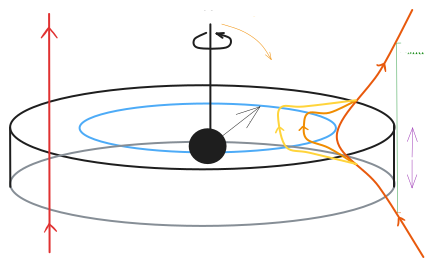
A visualization adapted from (Jafari 2019) of the geometry of accretion. The black hole is represented in the center with a nearly maximal dimensionless spin \(a=.94\). It is surrounded by a cylinder with vertical height \(H\), representing the scale of the accretion disk. The red line on the left represents the initially vertical magnetic field line, and the three on the right visualize how it bends in time with yellow representing the latest. The green line shows the bending length scale of the magnetic fields, \(\lambda_{\text{MRI}}\).
From equation 1, the stronger the magnetic field, the longer the \(\lambda_{\text{MRI}}\) becomes. When the maximum magnetic field strength is reached, \(\lambda_{\text{MRI}}\) becomes longer than the height of the disk \(H\), and the disturbances in the magnetic field lines can’t “fit” vertically in the disk. In this case, the MRI becomes strongly suppressed. As a result, the value of \(\lambda_{\text{MRI}}\) is an indicator of a transition between an MRI-powered accretion disk, and one of a MAD. (Nouri & Janiuk 2024) Furthermore, how receptive the magnetic field lines are to bending tells us about the upper limit of magnetic flux in the accretion disk. The longer \(\lambda_{\text{MRI}}\), the easier it is to bend the magnetic field lines. Analogously, if you take two pencils of different lengths, it requires less force to break a new pencil than when it’s heavily sharpened. When magnetic field lines are easier to bend, it is thus easier to create toroidal loops in the magnetic field that saturate the accretion disk and increase its magnetic flux.
Observations/Simulations
The accretion disk of these AGN is composed of highly magnetized and energetic plasma moving at relativistic speeds on a curved spacetime. As the qualities of the plasma suggest, we implement the study of general relativistic magnetohydrodynamics (GRMHD). In particular, the relativistic plasma found in the accretion flow is physically governed by a set of hyperbolic partial differential equations which complicate the possibility of precise solutions. As such, HARM, short for high-accuracy relativistic magneto-hydrodynamics, is a program capable of approximating the solutions to these equations using high-resolution simulations of accretion flow. (Gammie et al. 2003)) HARM treats the plasma in the accretion disk as a fluid providing an approximation that allows for simpler computation of disk evolution. Using the HARM scheme, we simulate a spherical cloud of non-relativistic gas at constant temperature. The black hole carries a nearly maximal dimensionless spin \(a=.94\), a ratio of our black hole’s angular momentum and its maximum possible angular momentum. (Lalakos et al. 2025) The larger the injected value of the dimensionless black hole spin parameter, the more powerful outflows like jets are become affecting the physical dynamics of the gas. (Lowell et al. 2024)
The grid of the simulation is configured to spherical Kerr-Schild coordinates, with a logarithmic radial grid spanning \(.83 r_{H} \le r \le r_{g}\) and polar and azimuthal grids ranging \(0 \le \theta \le \pi\) and \(0 \le \varphi \le 2\pi\). The simulation data captures the accretion process out to the dimensionless Bondi radius, \(r_{B}/r_{g}=1000\). Here, \(r_{B}\) is the Bondi radius, a measure of the radius of a region where an astronomical object begins accreting surrounding material, and \(r_{g}\) is the black hole gravitational radius. The black hole is located at \(r_{B}/r_{g}=0\). Within the dimensionless Bondi radius, accretion reaches inflow equilibrium such that the mass accretion rate thereafter does not change over the duration of the simulation. Within the dimensionless Bondi radius, \(\frac{r_{c}}{r_{g}}=300\), where \(r_{c}\) defines the circularization radius at which the accretion flow forms its characteristic disk shape.
The duration of the simulation is measured in units \(t_{g}=\frac{r_{g}}{c}\) and ranges from \(0t_{g}\le t \le 12.6 \times10^{5} t_{g}\). At the start of the simulation, we create a cavity out to the Bondi radius so as to avoid unwanted conditions that affect the evolution of the simulation. Figure 2 shows two contour plots of gas density at time \(t=0 \hspace{.1cm} \frac{r_{g}}{c}\) for visualization.
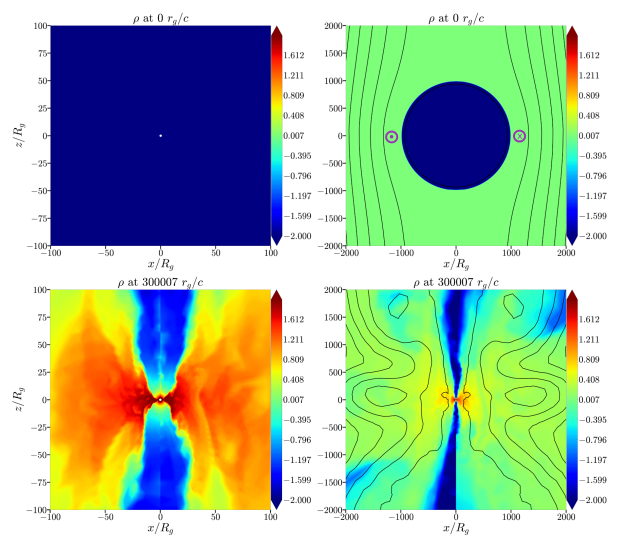
Countour plots of gas density as a measure of the \(x / R_g\) and \(z/ R_g\) coordinates. The top left and right plots show the measure at initial time \(t=0 \hspace{.1cm}t_g\) \(r_{g}\) at different length scales. The upper right plot includes two purple circles representing vector notation, indicating the direction of gas flow. Similarly, the two bottom plots are simulations of \(t=300007 \hspace{.1cm}t_g\) \(r_{g}\) when the MAD state occurs in the simulation
Analysis / Discussion
We now discuss the results of the dimensionless parameters \(\lambda_{\text{MRI}}/R\), \(H/R\), and \(\lambda_{\text{MRI}}/H\), that describe the physical nature of bending in the magnetic field lines, and thus provide an understanding of the conditions for when the magnetic flux in the accretion disk is at a maximum. Figure 3 shows the results of the three time-averaged parameters.
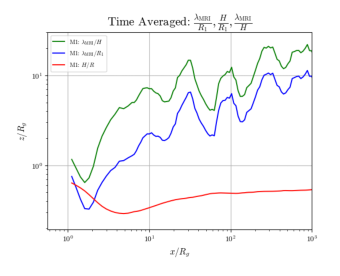
Time-averaged measures of \(\lambda_{\text{MRI}}/ R\), , \(\lambda_{\text{MRI}}/ H\).
For each of these calculations, the values were weighted with gas density in order to confine our measurements only the accretion disk rather than a combined consideration of the black hole. Our predictions of these three physical parameters in our simulation were expected to be approximately equal to those obtained by (McKinney, et al., 2012).
\(\lambda_{\text{MRI}}/R\) as a function of radius \(x / R_g\) tells us the dimensionless distribution of bending of the magnetic field lines. We predicted a value of \(\lambda_{\text{MRI}}/R\) \(\sim\) order unity, and found \(\sim\) 3 suggesting that, in our simulation, the MRI will eventually become suppressed. For the value of the dimensionless disk thickness \(H/R\), or the ratio of the scale height of the disk to the cylindrical radius, we found \(\sim\).6. This corresponds to our original prediction provided by the disc’s geometric half-angle thickness at maximum radius \(\theta^{d} \approx H/R\) found by (McKinney, et al., 2012). Such calculation of the thickness suggests that, for the MRI to drive the accretion process, the scale of bending must be at most .6. Lastly, the predicted value of \({\lambda_{\text{MRI}}/H}\) was \(\sim\) 2, yet we’ve found a value of 10. The maximum angle that the accretion disk can subtend corresponds to the maximum possible azimuthal angle of \(\theta^{d}_{\text{max}}=\pi\). Correspondingly, \(\theta^{d} =.6/\pi\), approximately a fifth of its maximum value, our prediction expected a value of \(\lambda_{\text{MRI}}/H\) \(\sim\) 2, yet we’ve found the full maximum possible value of \(\lambda_{\text{MRI}}/H\) \(\sim\) 10. This suggests that the physical scale of gas bending, or the \(\lambda_{\text{MRI}}\), spans nearly the entire polar angular range of the spherical volume of the simulation. Furthermore, the deficit in our expectation suggests that the susceptibility to bending of the magnetic field lines is higher than expected. Although we are still investigating this result, this tells us the fastest growing wavelength of the MRI can’t be vertically accommodated by the scale height, characteristic of strong magnetic fields. More research is necessary to both verify and interpret these results, but it could suggest there is additional matter outside the mid-plane that contains the accretion disk affecting the bending of the magnetic field lines.
Conclusions
The bending and receptivity to bending of magnetic field lines in the accretion disk tell us when it has reached its upper limit. Via 3D GRMHD, we simulated a spherical cloud of gas around a black hole with an ambient magnetic field. Over the course of the simulation, we found that the length scale for bending in the magnetic field lines was five times the value we initially predicted, suggesting the magnetic flux in the accretion disk has a greater than expected strength.
More work is necessary to understand the results of the simulation. As such, many of its parameters will undergo variation to provide confidence in the results we have obtained. In particular, the adiabatic index \(\Gamma\) controls the thickness of the disk, and for our simulation, \(\Gamma= \frac{5}{3}\) corresponds to the maximum thickness. (Lalakos et al. 2025) As such, it is of interest to understand the impact of smaller values of \(\Gamma\) and thus thinner disks to see if similar magnetic field line parameters are recorded. We are also curious to further understand deviations at later times from the MAD state in different simulations. More specifically, the jets and magnetic flux eruptions during the MAD state can disturb the inflow of angular momentum causing the rocking accretion disk (RAD) state.
Acknowledgments
I would like to acknowledge Northwestern University’s Center for Interdisciplinary Exploration and Research in Astrophysics Program as well as the National Science Foundation for their generous funding. In particular, thank you to Dr. Cliff Johnson, Director, and Dr. Megan Newsome, Co-Director, for their guidance.
References
Gammie, C. F., McKinney, J. C., & Toth, G. 2003, Astrophysical Journal, 589, 444–457
Noble, S. C., Gammie, C. F., McKinney, J. C., & Del Zanna, L. 2006, Astrophysical Journal, 641, 626–637
McKinney, J. C., Tchekhovskoy, A., & Blandford, R. D. 2012, Monthly Notices of the Royal Astronomical Society, 423, 3083–3117
Lowell, B., Jacquemin-Ide, J., Tchekhovskoy, A., & Duncan, A. 2024, Astrophysical Journal, 960, 82
Nouri, F. H., & Janiuk, A. 2024, Astronomy & Astrophysics, 687, A184
Jafari, A. 2019, arXiv preprint, arXiv:1904.09677 Magnetic Fields in Accretion Disks: A Review
Tchekhovskoy, A. 2015, in Astrophysics and Space Science Library, Vol. 414, The Formation and Disruption of Black Hole Jets (Berlin, Heidelberg: Springer), 45–82
Carroll, B. W., & Ostlie, D. A. 2017, An Introduction to Modern Astrophysics, 2nd edn. (Cambridge: Cambridge University Press)
Lalakos, A., Tchekhovskoy, A., Most, E. R., Ripperda, B., Chatterjee, K., & Liska, M. 2025, arXiv preprint, arXiv:2505.23888 Universal Radial Scaling of Large-Scale Black Hole Accretion for Magnetically Arrested And Rocking Accretion Disks
Poster
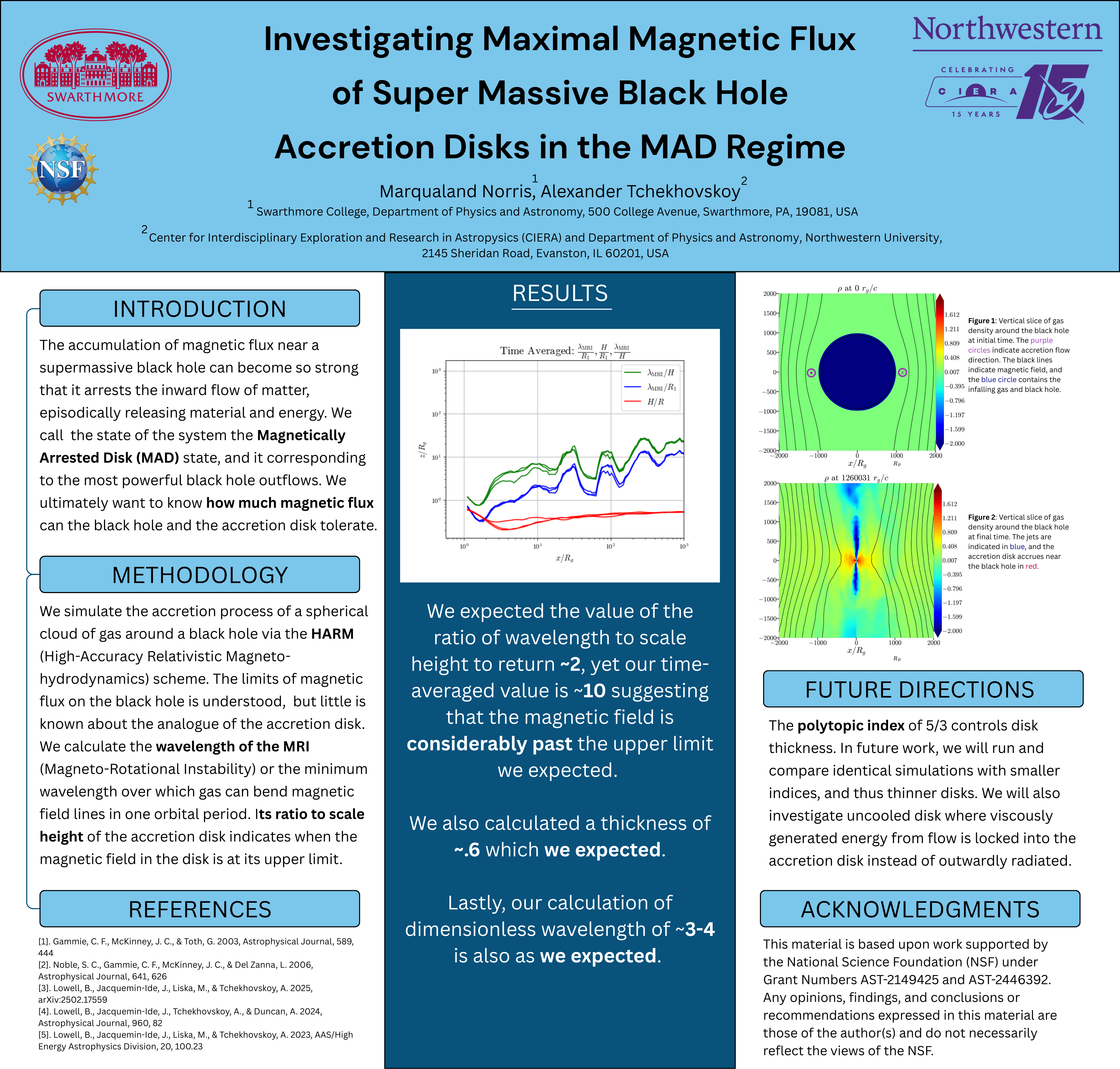
CIERA 2025 poster: Investigating Maximal Magnetic Flux of Super Massive Black Hole Accretion Disks in the MAD Regime
Download: PDF